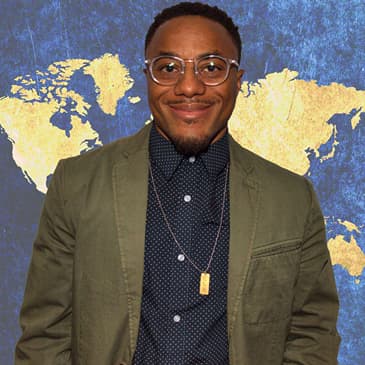

What happens when someone who has spent a lifetime as a patient also becomes a healthcare professional?
Nicholas Kelly has lived with cystic fibrosis since he was just three months old. But when you hear his story, you quickly realize that CF is only one part of who he is. Nicholas is a dietitian, educator, poet, author, speaker, and passionate advocate for patients and the CF community.
In our conversation, we talked about growing up with cystic fibrosis, the experiences that shaped him, and the reason he chose to become a dietitian—which, interestingly, had nothing to do with his CF.
But one of the things I found most fascinating was hearing Nicholas talk about healthcare from both sides of the relationship. He understands what it means to sit in the patient's chair, but he also understands what it means to be the professional sitting across from that patient.
And that perspective has made him a powerful advocate for something every patient deserves: a voice.
We talked about self-advocacy, what happens when patients don't feel heard, the importance of the patient-clinician relationship, and why patients need to recognize that they are an important part of their own healthcare team.
This is a conversation about chronic illness, certainly—but it's really a conversation about being seen, finding your voice, and taking an active role in your own life and healthcare.
In the five-minute snippet: He found me out! For Nicholas' bio, visit my website (link below).
Contact The Conversing Nurse podcast
Instagram: https://www.instagram.com/theconversingnursepodcast/
Website: https://theconversingnursepodcast.com
Your review is so important to this Indie podcaster! You can leave one here! https://theconversingnursepodcast.com/leave-me-a-review
Would you like to be a guest on my podcast? Pitch me! https://theconversingnursepodcast.com/intake-form
Check out my guests' book recommendations! https://bookshop.org/shop/theconversingnursepodcast
I've partnered with RNegade.pro! You can earn CE's just by listening to my podcast episodes! Check out my CE library here: https://rnegade.thinkific.com/collections/conversing-nurse-podcast
Thanks for listening!
[00:01] Michelle: What happens when someone who has spent a lifetime as a patient also becomes a healthcare professional?
[00:08] Nicholas Kelly has lived with cystic fibrosis since he was just three months old.
[00:14] But when you hear his story,
[00:16] you quickly realize that CF is only one part of who he is.
[00:21] Nicholas is a dietitian, educator,
[00:24] poet, author,
[00:26] speaker, and passionate advocate for patients and the CF community.
[00:31] In our conversation, we talked about growing up with cystic fibrosis,
[00:35] the experiences that shaped him,
[00:38] and the reason he chose to become a dietitian,
[00:41] which, interestingly,
[00:43] had nothing to do with his CF.
[00:46] One of the things I found most fascinating was hearing Nicholas talk about healthcare from both sides of the relationship.
[00:53] He understands what it means to sit in the patient's chair, but he also understands what it means to be the professional sitting across from that patient.
[01:03] And that perspective has made him a powerful advocate for something every patient deserves,
[01:09] a voice.
[01:10] We talked about self advocacy,
[01:13] what happens when patients don't feel heard,
[01:16] the importance of the patient clinician relationship,
[01:19] and why patients need to recognize that they are an important part of their own healthcare team.
[01:26] This is a conversation about chronic illness,
[01:29] certainly, but it's really a conversation about being seen,
[01:34] finding your voice and taking an active role in your own life and healthcare.
[01:39] In the five minute snippet,
[01:41] he found me out,
[01:58] Well, good morning, Nicholas. Welcome to the podcast.
[02:01] Nicholas: Thank you for having me. Good morning.
[02:04] Michelle: Thank you so much for reaching out.
[02:07] I really appreciate people that reach out and say, hey, this is what I got going on. And this is,
[02:15] I think I'll be of value to your audience, my message will be and let's talk.
[02:21] And so thank you so much for doing that.
[02:24] Nicholas: Thank you for having me. It's a real pleasure.
[02:27] Michelle: Well, thank you. We're going to get right into it.
[02:29] You were diagnosed with cystic fibrosis when you were just three months old, and it was actually your mother who recognized that something wasn't right.
[02:39] What do you know about those early days?
[02:43] Nicholas: So I just know I was a sick child.
[02:45] And 39 years ago, they didn't think African Americans could have the disease, so no one would test me for it.
[02:53] So that's why it was actually my mother who did the research and learned because no one would test me for it, because I was African American.
[03:01] Michelle: Just amazing. So 39 years ago puts you at the same age as my daughter. So you were born in 1986.
[03:12] Nicholas: Seven.
[03:13] Michelle: 87. So in 1987,
[03:18] I had been a nurse already for a little over a year,
[03:23] and I started out in pediatrics,
[03:26] and we had, I think for our small population, we had quite a few patients with cystic fibrosis that we saw in our little teeny, tiny unit of just 12 beds.
[03:39] So I do remember caring for those kids and their families.
[03:45] And I imagine that a lot has changed in 39 years, but you tell me.
[03:52] Nicholas: There's been a dramatic change over the years.
[03:58] And even recently, within the last five years,
[04:01] there's been a dramatic shift and life expectancy with these triple combo drugs coming out that have been miracle workers for some people. So there's a lot of hope in the community,
[04:15] and that's something that's amazing.
[04:17] Michelle: Yeah, I just.
[04:19] In my short tenure in pediatrics, I did 18 years in PEDs before moving to the NICU.
[04:26] I know as far as with asthma,
[04:29] it just was the metered dose inhalers were just a total game changer for our asthmatic patients. And so I can imagine with the advent of, as you said, all those new medications and treatments,
[04:44] that things are much better.
[04:47] Okay, so you have described your approach to life as not allowing cystic fibrosis to prevent you from having a normal life.
[04:57] Nicholas, what did your normal look like?
[05:00] Nicholas: Growing up,
[05:02] I was held to the same standard as my siblings, and I had the same expectations.
[05:07] So, you know, for some people, they wake up, they brush their teeth, they wash their face, they go eat cereal. For me, woke up, brushed my teeth, washed my face, did my treatment, at my cereal.
[05:17] But it was just part of my normal routine,
[05:21] so I didn't feel different doing it. It was just something added to my normal routine. My parents did a really good job making sure that I was incorporated in everything.
[05:30] It was just one part of my journey that was a step in the right direction.
[05:35] Michelle: Wow. I love that. Kudos to your parents.
[05:38] Very difficult to do,
[05:40] having a child with a chronic illness,
[05:45] to not,
[05:47] I guess I don't know if the word would be baby, the child.
[05:51] But to not give that child special treatment, in a way really, really hard to do for parents.
[05:59] Something that's really necessary to help you grow up having a normal life.
[06:07] Was there a point when you realized,
[06:09] I'm going to have to advocate for myself if I want to live the life that I want for myself?
[06:16] Nicholas: That didn't come till I was older. My mom did a really good job of advocating for me while I was younger, and I went through stretches where,
[06:25] I had to. When I was 16,
[06:27] I had to really advocate for myself and that the pain I was feeling was real. You know,
[06:34] so many people doubted the pain I was feeling in my stomach. So many people doubted it. So many people was like, you know, we did test over test, and they never found anything.
[06:42] So they start to question the validity of the pain and things of that nature. And I just had to stay steadfast and say, no, this is real. This is happening, until I was able to get answers.
[06:53] Michelle: Well, I mean, bravo to you again for advocating for yourself. But so sad that in the medical community we don't
[07:03] validate the patient's complaints.
[07:08] I think that
[07:10] Unfortunately, I think that that happens very frequently.
[07:15] What was it like growing up with a condition that required so much medical attention, but also just wanting to be a kid?
[07:25] Nicholas: It was challenging at moments,
[07:27] you know, being able to try to fit those things in. You know, you're ready to go outside and play, but you have to do your treatment.
[07:34] You know, those were the inconveniences of life. You know, you wanted to be able to go out and do everything, but you had to wait longer so it just.
[07:44] You notice there was differences.
[07:46] Even though, like I said, my parents did a good job of not making me feel different,
[07:51] but there were differences. And this is where you saw it when you wanted to do these different things and you had to be more conscious, you had to wait. Like, I played baseball,
[07:59] but I had surgery, open heart surgery when I was five. So I had to play with a chest protector. And one game I forgot my chest protector, so I couldn't even play.
[08:08] So I made sure I never made that mistake again. So you had these nuances and differences that came with the disease process.
[08:17] Michelle: Wow, that must have been really difficult. So when you talk about your treatment, like, you have to do your treatment, tell us kind of what did that entail?
[08:26] Nicholas: So a lot of bronchial hygiene, which is basically albuterol. Vests, percussions, different medications. Like, now I use what's called a bolero.
[08:39] Nicholas: I've tried a little bit of all airway clearance medication.
[08:43] So it's all with the idea of breaking up that mucus in the lungs and helping those secretions come out.
[08:49] Michelle: And so who does your percussion? Is that something that you can do yourself or how does that work?
[08:56] Nicholas: Nowadays, I use a vest,
[08:58] but when I was younger, it was my, we used to have a game who could hit Nick the hardest and the family would do my percussion. So whether it be my twin sister, my older sister, my cousin Alan loved doing it.
[09:10] He would beat me, he would love it.
[09:12] And so I, you know, it was just a family all learned how to do it, and everyone just kind of was part of the journey.
[09:21] Michelle: Oh, my gosh, that's too much. I love your sense of humor. I imagine that through all of this you've had to foster a sense of humor.
[09:31] Nicholas: Absolutely. You just, you know, I have realized life can be taken so seriously, but if you find the joy in the small moments, it makes it a lot easier.
[09:43] Michelle: Yeah. Wow, that's a great lesson. Well, you talked already about how your family approached you having cystic fibrosis. How did healthcare professionals approach your family?
[09:56] Nicholas: So that was kind of hard for me because my parents did a lot of that behind the scenes, if you will,
[10:05] because they didn't want me to have to carry the weight of my disease on my shoulders.
[10:12] You know, they were the ones having the conversations. They were the ones doing these different things.
[10:18] And for me,
[10:19] I got to see them advocate and say this is what my child needs, this is what my son needs,
[10:26] and that's where it's going to be. But in the same regard, a lot of the behind the scenes action was them making sure I got what I needed.
[10:35] Michelle: Do any of your siblings have cystic fibrosis?
[10:38] Nicholas: No.
[10:40] Michelle: And what about genetic testing? Did your family go through genetic testing at all?
[10:45] Nicholas: No, I have two rare mutations, so they didn't show up on genetic testing.
[10:50] Michelle: Wow.
[10:51] Nicholas: And back then, it was even slimmer, like now.
[10:54] Nowadays, some places are opening up the number of genetic testing. Ohio actually has one of the highest number of genetic testings for CF mutations in the country,
[11:04] actually, whereas some places only have two genetic tests. So with so many variations and so many rare variations, especially in people of color, it's hard to catch those people,
[11:16] those minority populations.
[11:19] Michelle: Oh, yeah. I imagine we had a family of three girls in our pediatric unit, and all three girls had cystic fibrosis.
[11:31] Nicholas: Whew.
[11:32] Michelle: Yeah.
[11:32] Nicholas: Lessons to their family.
[11:34] Michelle: Yeah, we grew up with that family.
[11:39] They were there all the time with either a couple of their girls or at least one of their girls pretty frequently.
[11:47] And the oldest ended up having a successful lung transplant.
[11:52] Nicholas: Oh, wow. That's amazing.
[11:54] Michelle: Yeah. Okay, well,
[11:58] now we're going to talk about the patient becoming the educator.
[12:03] So you ultimately became a dietitian.
[12:07] How much of that decision was influenced by your own experience with cystic fibrosis and nutrition?
[12:16] Nicholas: None.
[12:17] Michelle: Wow.
[12:17] Nicholas: Not even a little bit.
[12:21] So how I actually became a dietitian.
[12:24] So I went to college for computer technology.
[12:26] I wanted to build, like, the biometrics standards the FBI uses.
[12:30] The year I got to Bowling Green, they got rid of the major. They incorporated it into computer science.
[12:36] I hated computer science. I coded in multiple languages. I didn't like it.
[12:39] So I was planning on transferring schools, but I was gonna wait until the end of the semester just because the school I was gonna transfer to was in California.
[12:48] So my twin sister went to BG as well. She was a nursing major.
[12:52] So she started to take this nutrition class,
[12:54] and she was like, Nick, will you take the class with me? I said, absolutely not. I have no interest.
[12:59] So she came back and was like, oh, some of our friends are taking the class. Will you take it with me now? I said, absolutely not. You won't be alone.
[13:06] So she came back and said, all right, I'll make you a deal. I'll do most of your homework as long as you take the class and you can do all your in class stuff.
[13:14] And I said, all right, that sounds like a deal.
[13:17] So wrote it up.
[13:19] Wrote it up. I was in class the next day,
[13:21] and I sat there and I was in class, and the professor was Dr. Jillian. Wilfred. He wasn't a dietitian, but the way he talked about nutrition, it was like the greatest puzzle I'd ever heard.
[13:32] So I literally got finished with class, walked out, called my mom, said, mom, how do you feel if I was a dietitian? Changed my major the next day.
[13:40] Michelle: My goodness. Oh, my God. I love that story.
[13:44] Nicholas: Best part of it. My sister hated the class so much. I had to do her work.
[13:50] Michelle: I love that. Oh, my gosh. Okay, so, well, we just found out in there that you have a twin sister. So that's really cool.
[13:58] Michelle: Nicholas, this whole time as I was doing my research on you,
[14:04] I was thinking, he probably became a dietitian because he has cystic fibrosis and he's got that focus on nutrition.
[14:15] Okay, so you didn't only become a dietitian.
[14:19] You are an author of a cookbook for people who need more calories, more nutrition.
[14:28] Talk about how that happened.
[14:32] Nicholas: So one day, I was in the backseat of my friend's car,
[14:37] and we were having a conversation,
[14:39] and I sat there and I was looking out the window, and all of a sudden I go,
[14:44] what is there for the athletes?
[14:46] There's all these cookbooks, but what about athletes?
[14:49] Everyone talks about low calorie, low calorie, and for good reason.
[14:53] But I was like, what about high calorie for the people who need it? You talk about athletes eating like Michael Phelps at the time, you know, needing 3-4000 calories, eating 5, you know, cheeseburgers and stuff like that.
[15:05] I was like, what if I could create something where it's high calorie and it's good meals?
[15:10] And that's where the idea was originally born.
[15:14] And I followed through with it. It was seven. It took me seven years to finish my cookbook,
[15:20] I was able to complete it and make what I think, you know, I'm a little biased, a masterpiece.
[15:24] Michelle: It is so cool.
[15:29] You know, you're absolutely right.
[15:31] I just don't think there's anything like that on the market.
[15:35] Not that I have looked for anything like that, but when I came across it,
[15:39] I said, this is brilliant.
[15:41] You can see that I have some extra adipose tissue.
[15:46] Right. And so I,
[15:49] being overweight, am always looking for cookbooks that have recipes, as you said, that are lighter and,
[15:58] less calories, less fat, stuff like that.
[16:02] And when I came across your cookbook, I thought, oh, my gosh, this would be like a total dream for me,
[16:10] Who doesn't need all the extra calories to be able to fix something so incredibly nutritional, but also decadent and all those extra calories.
[16:22] But I think it's such a gift to so many people out there and, and not only people with cystic fibrosis, but as you said, athletes who need more calories, more nutrition.
[16:38] Also people with chronic illnesses that have trouble putting on weight or keeping weight on.
[16:44] It's just brilliant. And isn't it weird how sometimes ideas come to us?
[16:50] You know, you're in the backseat of your friend's car and it just pops in your head. It's. Sometimes I think those things are divine intervention.
[16:59] Nicholas: Yeah, it was just,
[17:02] the reason I, you know, love my cookbook is it's for people who need those calories, but also there's people just who need comfort food every now and again. And that has a lot of comfort food meals in there.
[17:16] And so it's that nice balance between,
[17:18] you know, being able to just need calories versus meeting just wanting a comfort food meal. And so that's an amazing kind of thing. And you're right. It's kind of divine intervention.
[17:28] It just came to me at,
[17:30] you know, it just became a idea that I work really hard to make a reality.
[17:36] Michelle: Yeah. I guess, I mean, seven years of research and putting it all together.
[17:42] So let's talk about that a little bit. People sometimes think of nutrition as just kind of eating healthy. Right.
[17:49] But for someone with cystic fibrosis or those other chronic illnesses that zap people of nutrition,
[17:58] it can be a little bit more complicated. What do you wish people understood?
[18:03] Nicholas: Nutrition is an entire being, like, you know, eating healthy,
[18:09] understanding eating times,
[18:11] you know, understanding like different foods and how they affect the body.
[18:16] And all these different elements and components can kind of make up nutrition. And I always tell people, and I've learned nutrition is a science. What you choose to eat is an opinion,
[18:29] and that's the biggest thing. Nutrition is a science.
[18:33] Michelle: Yeah. Wow. Absolutely. I mean, when you think about all the macronutrients and the micronutrients and. Yeah, definitely a science. But we don't treat it like that, right?
[18:47] Nicholas: Not often enough.
[18:50] Michelle: Exactly.
[18:52] So you've been on both sides of the healthcare relationship. You've been the patient with cystic fibrosis and you are the professional.
[19:03] How does being a patient inform the way you care for or educate other people?
[19:09] Nicholas: Clinicians never or often will never know what it's like to be a patient, and a patient will not know what it's like to be a clinician.
[19:16] So I do what I can to bridge that gap. So when I'm teaching clinicians, it's all about understanding that communication gap, understanding how we can focus on increasing patient outcomes and patient satisfaction.
[19:29] And when I'm talking to patients, it's always trying to understand what their rights are,
[19:34] understanding how to advocate for themselves, and understanding, like the clinician perspective on some things as well.
[19:43] Michelle: Wow. I, I bet you're very effective in, in bridging that gap just because of the fact that you have experience on both sides and you can see the discrepancies of both sides of the road or whatever.
[19:58] So let's talk about advocacy, because you probably,
[20:01] when you talk to patients, you encourage them to advocate for themselves.
[20:06] And what does effective self advocacy,
[20:09] actually look like, really?
[20:13] Nicholas: It's just being able to know your rights,
[20:17] learn your information,
[20:19] and speaking up for yourself,
[20:22] being able to champion for yourself.
[20:24] No one is going to care about your health more than you do.
[20:28] And you can have people who love you, who care about you, your clinicians could care, but no one will care about your health more than you do. So it's pivotal that you take that information and you advocate for yourself and just,
[20:41] you know, we see discrepancies in the healthcare field consistently, and there's plenty of examples.
[20:46] So you want to be able to speak up and say, this is what I need.
[20:49] This is what I'm not getting. This is what I feel.
[20:52] And advocating for yourself, my pain is real. Like, for my situation, my pain is real.
[20:58] So just being able to advocate for yourself is.
[21:01] huge. But it starts with having the information, knowledge, and then being able to articulate it in such a way that you can say, and it doesn't have to be fancy, it just has to be in a point where you people can understand what you're going through.
[21:15] Michelle: What should someone do when they feel like their concerns are not being heard? This goes for family members as well, parents, you know, of children.
[21:25] Nicholas: So people, number one,
[21:28] you're not tied to your clinician.
[21:30] There's other clinicians out there, and it's okay. You know, in a way, the clinicians work for you,
[21:37] so you can fire them and you can get a new clinician. You know, sometimes people are people. Sometimes people just don't gel.
[21:46] And so that's something important for people to understand.
[21:49] And it's a part of the business.
[21:51] And so that's one thing.
[21:53] Another thing is being able to come at the conversations in different ways. You know, making sure there's other people on the staff who can help you and might be able to better understand and help you.
[22:05] You know, maybe the social worker can help translate the information better, maybe the nurse practitioner. You know, these people are on the team.
[22:14] Utilize them, because sometimes they're able to articulate what you're trying to say in a better way, and it might help.
[22:20] So utilize your team as well.
[22:23] Michelle: Great advice. Yes, utilize your team. And it should be a team approach,
[22:27] and the patient should be at the center of that team.
[22:30] And, you know,
[22:31] from the nursing perspective,
[22:33] what can nurses do when a patient is asking questions, pushing back,
[22:38] or challenging a plan?
[22:42] Nicholas: The nurse's job and role is pivotal because they're like the bridge, the gateway to the clinic, to the doctor,
[22:50] to the physician. So I think it's really important that the nurse does the best job they can to understand what the patient's going through so they can relay that message.
[22:59] So they're the first line of defense. And I feel like when you're the first line of defense, you're the most important line of defense because you're the one who has to navigate what the patient is feeling in real time and then being able to translate those emotions, those feelings,
[23:14] but those concerns into a productive way and trying to Navigate that productive way.
[23:21] Michelle: Yeah, I love that. You said they're like, they're the bridge between the patient and the physician or the provider,
[23:28] and that's certainly true. And they're the advocate as well.
[23:32] And you want them on your side. Right? And they want to be on your side, too.
[23:39] Tell me about some of the nurses that you've encountered,
[23:42] some of the things that have been helpful that they've done, and maybe some of the things that have not been helpful.
[23:49] Nicholas: You know, I've had some of the best nurses ever,
[23:52] and that was one of the biggest blessings I've ever had. When we had our own CF floor,
[24:00] the nurses just were so compassionate. They were so dialed into who we were as individuals, and they did everything they could to make sure that we were comfortable.
[24:11] And so those experiences, from celebrating our birthdays to just remembering the candy we liked, you know, those little things went a really long way.
[24:22] You know, just making it joyous to be in the hospital.
[24:25] Whereas, you know, when we moved from that center, it was a really rough transition because a lot of the nurses didn't know about CF and so it was hard.
[24:35] You know, I tell people,
[24:36] in 95% of the rooms, nurses go in, they're going to be the expert.
[24:41] CF is not that case where they're not the expert. It's usually the patient who's the expert. And so that's a tight transition. And that can be rough for some nurses or even some practitioners, not just nurses, but that can be rough when they're not the expert.
[24:58] And so sometimes you gotta put your ego to the side and accept help.
[25:03] Michelle: Wow. Okay. Can you put that on blast?
[25:07] Nicholas: Yeah, man. Say it louder for the people in the back.
[25:10] Michelle: That's right.
[25:12] That, I mean, that is just a hundred percent true. Sometimes you gotta put the ego to the side.
[25:18] And, you know,
[25:20] growing up in, I say, growing up in our pediatrics unit, I was a very young nurse, 21 years old,
[25:27] starting. I didn't know shit. I didn't know anything. Okay. I just knew what I learned in nursing school,
[25:34] and that was not a lot.
[25:36] And so when you get out on the floor and you're taking care of these kids and they come attached with parents,
[25:44] and the parents of these kids are bringing in huge binders of information that their kids have gone through,
[25:55] all the different doctors they've seen, all the different medical institutions that they've been to, the surgeries, they've had the medications,
[26:04] and I consider myself someone with a pretty healthy ego.
[26:09] But in that context, man, I just said,
[26:13] tell me what you got. Show me what you got. Like, teach me. And I let them become the teachers.
[26:21] And I think that's just one of the best things that I could have done in my career is really just put that ego aside and say, look, I don't know about this and I want to take good care of your child.
[26:35] So you teach me. And I think it just opens up such a good relationship.
[26:42] Nicholas: Absolutely.
[26:43] Michelle: Yeah. Fantastic.
[26:45] So I want to shift from illness to identity, creativity and purpose. Nicholas,
[26:52] because you're not only a dietitian and an educator,
[26:56] a speaker,
[26:57] you're also a poet. And we talked about your authorship.
[27:02] Where does the artist in you come from?
[27:05] Nicholas: I've always been a creative,
[27:07] and that's something that's always been a part of me. Poetry is my first love. So it started with poetry, and then I became a professional dancer. I was a professional dancer for 12 years.
[27:18] And then in addition to that, I DJ and I do photography and I draw.
[27:24] So all those creative outlets were just a part of me. They were a part of me that I was able to foster and enjoy and grow.
[27:33] Michelle: Do you think those would have been there if you didn't have cystic fibrosis? Do you think having CF influenced your creativity?
[27:44] Nicholas: I don't know.
[27:45] You know, maybe chicken or the egg type of situation? I can't say.
[27:50] You know,
[27:51] CF has provided me a lot of things.
[27:53] I'm not sure if my creativity is one of those that I would attest to it,
[27:57] but how I've utilized it is been impacted by CF.
[28:03] Michelle: Yeah. And also, you didn't let your CF get in the way of your creativity and saying what you can do and what you can do.
[28:12] You know, you're a dancer for 12 years. I mean, that's phenomenal.
[28:16] And,
[28:17] yeah, I would love,
[28:19] Do you have a short poem that you could share with us?
[28:25] Nicholas: Let's see. I'll just. I'll go.
[28:27] Nicholas: I'll just share. I'll just do a poem.
[28:29] So I don't have one. I share, but I'll just do a poem. I'll do one on the spot for the audience. It's freestyle.
[28:35] Michelle: Wow.
[28:35] Nicholas: Alrighty.
[28:37] Moments.
[28:38] There's moments in time that fade, fading away so fast, every lasting looking in vastly into the sky the stars above are what we seek every time I seek, every time I peek it's like hide, no seek But I'm trying to find my soul my soul is to enter and pass, that passing of the passing of the torch, that torch, I'm burned, it's fire inside me, I burn the fire inside me that I can only let go
[29:03] I will never let die, Hide and seek, I'm seeking, I'm seeking time, I'm seeking the absolute, absolute, absolute time that my brain can be only fine. My brain can find everything we love I'm seeking, I'm seeking this is how I go seek but the thing I seek is the passion inside of me.
[29:22] Michelle: Phenomenal. Wow.
[29:23] That's amazing. Just on the spot.
[29:26] I can feel your passion in there.
[29:30] So chronic illness, you know, it's not always inspiring,
[29:34] right? Sometimes it's exhausting. It's frustrating,
[29:38] it's unfair.
[29:39] How do you make room for those emotions while still choosing hope?
[29:46] Nicholas: It's just a choice. That's the biggest thing. It's a choice. Like, you know, I always tell people, I never play the who's sicker game. I never play the woe is me game.
[29:54] Those aren't things I do because those aren't helpful.
[29:57] Those aren't beneficial. You know, having CF sucks. I'm not going to sit here and lie and tell people like, oh, it's all puppies and rainbows, because it's not.
[30:05] But how I control my CF, how I control having CF, that's my choice.
[30:11] And I do what I can to choose to be positive,
[30:16] To be really just positive.
[30:19] You know, I make that choice.
[30:22] Michelle: It is a choice. And thank you for reminding us of that. I think sometimes we forget that because we can get really just overwhelmed by all of the things that are happening to us having a chronic illness.
[30:38] And we forget that we have a choice in our attitude and in how we want to present ourselves, how we want to communicate.
[30:49] And I'm sure there are many days where you have maybe not felt like going to work and doing all the things, but you just get up and do it anyway.
[30:59] And that is applaudable.
[31:04] Nicholas: The grind doesn't stop, for whatever reason, the world doesn't care that you're sick.
[31:10] So what you have to do is make the choice if you're going to continue forward or if you're going to let the world pass you by because it's going to keep moving forward regardless of what you do.
[31:19] Michelle: Time just keeps marching right.
[31:22] Nicholas: Hey, it keeps marching forward.
[31:25] Michelle: Yeah, that sounded so, like that
[31:29] comment about the world doesn't care that you're sick.
[31:34] Man, that, like, hit me right in the,
[31:37] Right in the solar plexus.
[31:39] For some reason, it sounds so heartless and so lonely.
[31:44] But it is actually so true.
[31:48] And you have to,
[31:50] You have to look out for yourself.
[31:52] Nicholas: I mean, it's very true. It's just. That's the nature of the beast,
[31:56] and that's why you have to be able to navigate through that. And that's a huge part of being able to navigate.
[32:04] Michelle: Yeah. If you had time to sit down with a person that was newly diagnosed with cystic fibrosis or another chronic disease, what would you want them to know that maybe you didn't know early on?
[32:20] Nicholas: The best thing you can do is find hope early as possible.
[32:26] Get thick skin and be adaptable. Those are the three things I think most people really may not understand or may not know early, but those are the three things.
[32:36] Get hope as soon as you can be adaptable and develop thick skin.
[32:42] Michelle: Who do you need that thick skin from? And what are you protecting?
[32:47] Nicholas: The world. The world is not kind. The world is not nice. So you need that thick skin from the world.
[32:54] Michelle: Wow. Very good advice.
[32:56] All right, in closing, I have one more question for you. Because you have spent your life advocating for people to see beyond a diagnosis.
[33:08] What do you hope people learn about themselves when they hear your story?
[33:14] Nicholas: That my story is just one story,
[33:16] but let my story be an example how to guide their story.
[33:20] You know, I would love if someone took away anything from me. It's like Nick lived with passion, and passion is what drove him. Passion is what allowed me to do these things.
[33:29] And people,
[33:30] if you find your passion,
[33:32] it will allow you to drive you into places that you didn't know were possible.
[33:38] Michelle: Well, I certainly see your passion and I hear your passion today.
[33:42] And this has been such an uplifting conversation.
[33:47] I'm really glad that you reached out and that we met and had the opportunity to talk.
[33:55] Nicholas: Absolutely. It was so, so much fun and it was an absolute pleasure. So I appreciate you.
[34:02] Michelle: That's been fun with for me too.
[34:05] Okay. For people that want to reach out and find you and find your cookbook, where do they. And find your poetry. Where do they do that?
[34:13] Nicholas: So Nicholas Kelly, rd.com. so that's Nicholas Kelly. K E L L Y R is in registered d as in dietitian.com or you can find me on my socials, which are at Nicholas Kelly, RD.
[34:27] And that's on all my socials. And my email is nicholaskellyrd@gmail.com so if you guys didn't see a pattern, the way to find Nicholas is Nicholas Kelly, RD. That's the way to find Nick.
[34:40] Michelle: I love it. Okay, I will put all those in the show notes.
[34:43] Super fun, Nicholas.
[34:45] Love it.
[34:46] Love talking to you. Love seeing your smile.
[34:49] I'm so glad that you brought all of your experience and your expertise and your knowledge and your wisdom to our audience today.
[35:01] Nicholas: Absolutely. It was a pleasure. I appreciate being had.
[35:05] Michelle: Well, we're at the last five minutes and
[35:08] if you've heard my show, you know, the last five minutes,
[35:12] we do a fun little segment called the five minute snippet. And it's just a way for our audience to see the off duty side of Nicholas when he's not dietitian and a speaker and an author and a poet.
[35:26] So it's usually fun. There's lots of giggles. Are you ready to play?
[35:30] Nicholas: I'm ready.
[36:12] Okay, first question.
[36:14] If you couldn't be a dietitian, Nicholas, what career would you choose?
[36:20] Nicholas: I would go back into technology. I love technology. Like I'm a tech nerd, so I would go back into technology for sure.
[36:28] Michelle: Okay. That's a really good field. It's a lot of job security in tech, right?
[36:35] Nicholas: Hey, the world is technology based.
[36:39] Michelle: Yep. Okay, what's your ultimate comfort food?
[36:44] Nicholas: Tacos. My favorite food is tacos. My second favorite food is cereal, which could be my first, but technically it's a group.
[36:50] Michelle: I love it. I could eat tacos every day. Tacos and pizza, and I would never get tired of it.
[36:58] Nicholas: Yeah, I could eat tacos every day for sure.
[37:01] Michelle: What's your favorite kind of cereal?
[37:04] Nicholas: Corn pops.
[37:05] Michelle: Oh, my God, that takes me back. Corn pops. I think I grew up on those. Fun. Okay. Your Best purchase under $100.
[37:16] Nicholas: Best purchase under $100.
[37:22] Michelle: There's not much under $100 today, probably.
[37:28] Nicholas: Ooh. I'm trying to think that under a hundred dollars gets you.
[37:32] All the things that I really love were all over 100 dollars.
[37:37] They were all over 100.
[37:39] I'm gonna say my Spider man game. I absolutely love that game. That brought me so much joy playing that game.
[37:48] So I'm gonna go with that.
[37:50] Michelle: Love it. I was gonna say you could buy a lot of boxes of corn pops for $100.
[37:56] Nicholas: Oh, my gummies. I eat gummies a lot. So I even have a gummy budget, like, each month, I'm allotted a gummy budget.
[38:04] Michelle: Oh, my God. Love it. Okay, you have one hour completely free with no responsibilities. What are you doing?
[38:13] Nicholas: I'm going to play some sports.
[38:16] I'm gonna do some, I would do sports.
[38:21] I would binge watch a good show.
[38:24] I would start going to breakfast and I would go see a movie and then go get a mani-pedi.
[38:31] Michelle: Oh, my God. That sounds like one packed hour. Okay.
[38:36] Nicholas: Yeah. So inside of that, like, the movie may not happen because it's only an hour, but yeah,
[38:43] like the movie won't happen, but the rest of it will inside of the hour.
[38:48] Michelle: Okay. What's a song that can instantly change your mood?
[38:53] Nicholas: Can you help me? By Usher. It's my favorite song of all time. Immediately.
[38:58] Michelle: Can you help me? Okay,
[39:00] I don't know that one. I don't have a wide,
[39:03] Usher's not in my playlist yet, but maybe I'll check that out.
[39:08] Nicholas: Yeah, yeah, Usher's not in your playlist. You gotta upgrade the playlist.
[39:12] Michelle: Yeah, I know, right? Hey, Taylor Swift is in my playlist.
[39:17] Nicholas: Oh, my goodness. A Swifty, I knew it. I knew it.
[39:23] Michelle: It's so funny, that story, because I'm 62 years old. So when I turned 60, I discovered Taylor Swift. Okay.
[39:32] And my niece is,
[39:34] early 30s, and I remember texting her and saying,
[39:38] aren't I too old to be a Swiftie? She's a total swiftie. And she's like, no, Aunt Michelle, you're not. This is awesome.
[39:48] So, okay, last question.
[39:50] There's a billboard by the side of a major highway with your picture on it. Nicholas,
[39:56] what is the message?
[39:59] Nicholas: Live with passion. Find your purpose. Increase your productivity.
[40:04] Michelle: Wow. Love it. Let's get those billboards out everywhere.
[40:09] Nicholas: There it goes. Passion is the single most important and single most attractive thing somebody can have, passion.
[40:15] Michelle: Yes. Totally agree with that. Thank you for bringing your passion today, Nicholas. I appreciate you and I hope you have a great rest of your day.
[40:25] Nicholas: Thank you so much for having me and being able to share my passion. And so you have a fantastic day.
[40:31] Michelle: Thank you so much.